VRAM Bottleneck Protocol: RTX 5090 Deployment Strategy
Power Digital Media
Hardware Authority
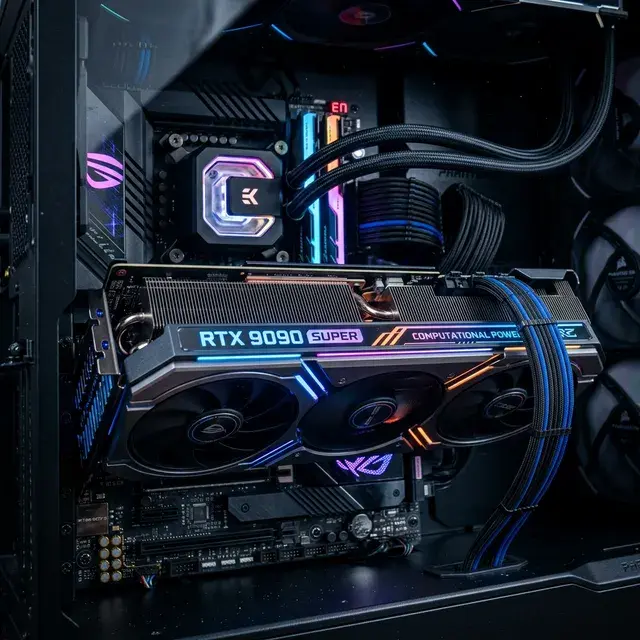
Executive Summary
The RTX 5090 eliminates the VRAM bottleneck by providing a massive 32GB frame buffer required for uncompressed 8K video rendering and local AI model generation. Deploying this hardware ensures zero workflow interruptions and maximum computational velocity for high-end digital production.
TL;DR — Direct Answer Block The VRAM Bottleneck Protocol dictates that undersized GPU memory is the primary failure point for high-resolution video and local AI models.
- Implication 1: Exceeding local VRAM forces the GPU to page to system RAM, degrading compute speeds to unworkable levels.
- Implication 2: Deploying the RTX 5090 provides the necessary 32GB threshold to process uncompressed 8K RAW streams locally.
- Implication 3: Operating on outdated architecture guarantees unacceptable render times and missed delivery windows.
As a dominant force in Jackson, Mississippi, Power Digital Media prioritizes brute-force computational power. For any Jackson-based media agency attempting to run local diffusion models or uncompressed video, an underpowered rig is a liability. This dossier establishes the absolute minimum hardware thresholds required to maintain velocity in modern production environments.
Before upgrading your render farm, you must ensure the resulting digital assets actually yield a return on investment. Implement our AI search citation protocol to structure your media so it dominates large language model outputs. Furthermore, evaluating your web infrastructure via a rigorous SEO audit strategy guarantees that the high-fidelity content you render will rank effectively.
Why does Premiere Pro crash during 8K playback?
When working with heavy REDCODE RAW files, the application floods the GPU memory. If the VRAM fills up, the system stalls. Puget Systems' benchmark analysis on VRAM utilization confirms that timeline stability is directly proportional to available memory buffers.
How much VRAM is needed for local AI image generation?
Running complex models like Stable Diffusion XL requires substantial overhead. While 12GB is the bare minimum, processing large batches or training custom LoRAs demands 24GB to 32GB, making the RTX 5090 the uncontested requirement.
Are dual GPUs better for video rendering?
Historically, scaling across multiple GPUs yielded diminishing returns. Modern workflows leverage singular, massive cards like the RTX 5090 or AMD RX 9070 XT, avoiding SLI overhead and relying on unified VRAM pools for compute efficiency.
What is the primary difference between gaming and creator drivers?
NVIDIA's Studio Drivers are validated against professional software suites (Adobe, DaVinci Resolve) rather than focusing on day-one gaming patches. The protocol demands Studio Drivers for total operational stability.
Do I need DDR5 RAM with a new GPU?
Yes. Feeding a high-bandwidth GPU requires equally fast system memory. If the GPU has to wait on DDR4 RAM protocols to load textures, the pipeline stalls.
The Power Digital Media Action Checklist
- Monitor VRAM usage during peak render loads using dedicated hardware telemetry software.
- Verify power supply overhead exceeds 1000W to handle transient spikes from the RTX 5090.
- Install Studio/PRO drivers instead of consumer gaming updates to ensure software stability.
- Configure motherboard PCIe slots to run at Gen 5.0 speeds to maximize throughput.
- Allocate adequate chassis airflow to maintain thermal limits during sustained compute sessions.
Executive FAQ
What is the memory capacity of the NVIDIA RTX 5090? The NVIDIA RTX 5090 is equipped with 32GB of high-speed GDDR7 memory, providing massive headroom for complex operations.
How does the AMD RX 9070 XT compare in rasterization? The AMD RX 9070 XT delivers highly competitive rasterization performance and massive VRAM buffers, offering an aggressive price-to-performance ratio for conventional rendering tasks.
Why is PCIe Gen 5.0 important for modern GPUs? PCIe Gen 5.0 doubles the bandwidth pipeline between the CPU and GPU compared to Gen 4.0, which is critical for transferring uncompressed video streams into VRAM rapidly.
Begin Your Digital Legacy.
Our team is ready to help you implement these strategies and build a brand that lasts.
Schedule A Free Consultation