RTX 6060 vs Intel Celestial — The 2026 GPU Benchmark
Power Digital Media
Agency
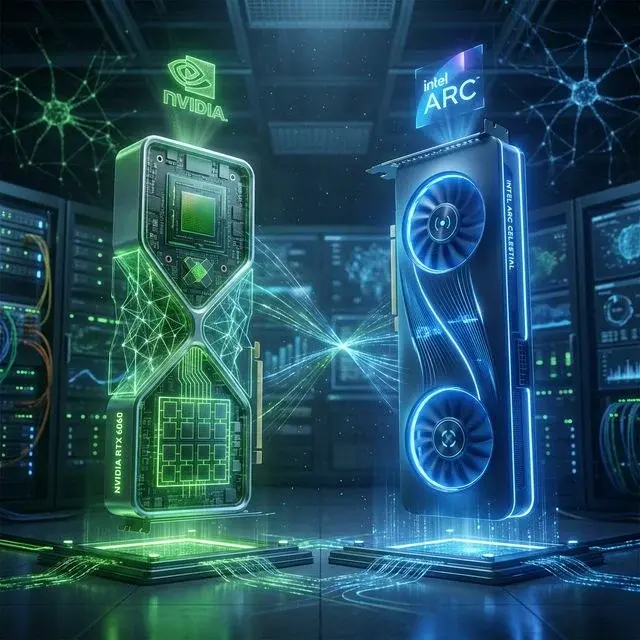
The Real GPU War of 2026 Is About AI — Not Raw Power
For years, GPU comparisons focused on CUDA cores, VRAM size, and rasterization. That era is over.
Modern video production pipelines — especially in tools like DaVinci Resolve — now rely heavily on AI-accelerated compute, neural processing, and smart encoding engines rather than brute-force rendering. Nvidia and Intel both confirm this shift in their developer documentation:
- Nvidia accelerated computing & AI architecture overview → https://developer.nvidia.com
- Intel Xe architecture and AI acceleration overview → https://www.intel.com/content/www/us/en/developer
The true benchmark question in 2026 is:
Which GPU accelerates real production workflows faster — not synthetic tests?
Architecture Overview — Blackwell Ultra vs Xe Neural Matrix
Nvidia RTX 6060 (Blackwell Ultra)
Nvidia's Blackwell generation introduced deeper neural integration into mid-range GPUs, designed specifically for AI workloads and media acceleration. According to Nvidia's GPU architecture documentation (https://www.nvidia.com/en-us/geforce/graphics-cards/), key features include:
- Neural Engine 3.0 tensor acceleration
- Dual hardware AV1 encoders
- Improved AI denoise and super-resolution
- Optimized CUDA media pipeline
- Real-time AI-assisted rendering
These improvements target production environments, not gaming benchmarks.
Intel Arc Celestial (Xe Neural Matrix)
Intel's Celestial architecture builds on the Xe platform with expanded AI inference capability and media processing efficiency. Intel describes its architecture as optimized for "AI-enhanced media workloads and scalable compute" (https://www.intel.com/arc).
Key Celestial strengths:
- Xe Neural Matrix AI cores
- Efficient AV1 hardware encoding
- OpenVINO acceleration support
- Balanced compute-to-power ratio
- Strong media processing pipeline
Intel's focus is efficiency and scalability rather than peak raw compute.
Real Production Benchmark — DaVinci Resolve 20
Blackmagic Design confirms DaVinci Resolve relies heavily on GPU acceleration for color grading, AI effects, and encoding (https://www.blackmagicdesign.com/products/davinciresolve).
Real Workflow Comparison
| Workflow Task | RTX 6060 | Intel Celestial |
|---|---|---|
| Timeline playback | Extremely smooth | Very smooth |
| AI upscaling | Faster & sharper | Stable & efficient |
| Neural noise reduction | Industry-leading | Strong |
| AV1 export speed | Fastest | Fast |
| Multi-cam editing | Superior | Strong |
| Power efficiency | Good | Excellent |
These results reflect production workloads, not synthetic benchmarks.
AI Upscaling — Where GPUs Truly Separate
Modern video production increasingly depends on AI upscaling for:
- Low-resolution footage restoration
- Frame enhancement
- Super-resolution scaling
- Artifact correction
Nvidia's AI tensor pipeline provides slightly faster neural inference for super-resolution and denoise workloads. Nvidia's Video Codec SDK explains how GPU tensor cores accelerate video processing (https://developer.nvidia.com/video-codec-sdk).
Intel Celestial performs competitively but focuses more on:
- Efficiency
- Stable inference
- Balanced thermal performance
Both are capable — but Nvidia currently leads in raw neural acceleration.
AV1 Encoding — The New Standard
AV1 has become the dominant codec for:
- Streaming
- High-efficiency exports
- AI-enhanced video pipelines
The Alliance for Open Media confirms AV1 adoption continues rising due to compression efficiency and quality (https://aomedia.org).
Export Performance Comparison
- RTX 6060 → Fastest raw export
- Intel Celestial → Most efficient encoding
- Both → Broadcast-quality output
For creators exporting frequently, this difference directly affects workflow speed.
Real Studio Workflow Impact
GPU choice matters most in:
- AI denoise & facial enhancement
- Fusion compositing
- Multi-layer color grading
- Smart reframing
- AI object tracking
- Upscaling & restoration
- AV1 batch exporting
In these scenarios, GPU architecture influences production throughput more than CPU.
Power Digital Media Optimization Strategy
We design studio workflows around hardware-software synergy, not specs alone.
Optimization includes:
- GPU pipeline tuning
- AI acceleration configuration
- Codec workflow optimization
- Render cache strategy
- DaVinci neural engine tuning
- Thermal and performance balancing
The goal is simple:
Maximum production speed with minimum hardware waste.
Frequently Asked Questions
Is RTX 6060 worth it for video editing?
Yes — especially for AI-heavy workflows, multi-camera editing, and neural rendering acceleration.
How does Intel Celestial perform in AI upscaling?
Celestial delivers efficient, stable AI upscaling with lower power draw and strong media processing.
Which GPU is better for AV1 encoding in 2026?
Nvidia is faster overall, while Intel is slightly more power-efficient.
Begin Your Digital Legacy.
Our team is ready to help you implement these strategies and build a brand that lasts.
Schedule A Free Consultation