WebMCP: Why Your Website Must Become an AI API
Power Digital Media
Hardware Authority
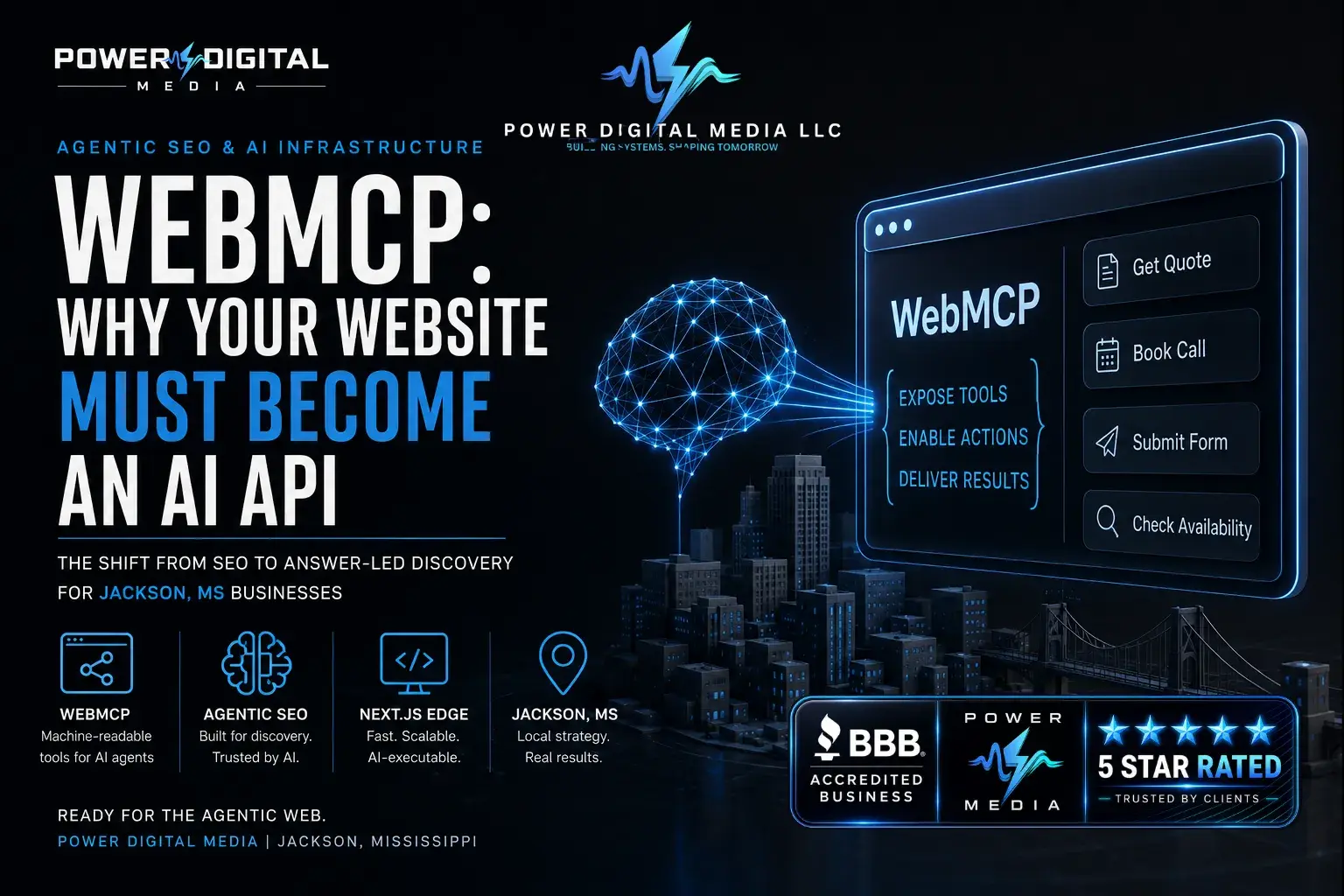
WebMCP: Why Your Website Must Become an AI API
TL;DR — Direct Answer Block The discovery model is shifting from search-only visibility to agent-led execution. WebMCP is the protocol layer that transforms a website from a static document collection into a machine-readable API surface that AI agents can query, compare, and act on directly.
- Implication 1: Businesses that expose structured data through machine-readable endpoints gain priority citation from AI assistants performing on-behalf-of research.
- Implication 2: Traditional SEO alone no longer guarantees visibility. Agentic SEO requires explicit entity declarations, JSON-LD schema, and structured service descriptions.
- Implication 3: The competitive moat in 2026 is not just ranking on page one. It is being the answer an AI agent selects, trusts, and recommends to the end user.
At Power Digital Media in Jackson, Mississippi, we execute digital infrastructure protocols that treat AI discoverability as a first-class engineering requirement. For Jackson business owners still measuring success purely by Google page rank, this is the operational shift you need to understand. The search game is changing faster than most operators realize, and the businesses that re-architect now will dominate the next referral cycle.
For years, the goal was simple: build pages, rank on Google, win the click, and hope the visitor converted. That model is not dead overnight, but it is no longer enough. In 2026, discovery is moving from search-only visibility to agent-led execution.
A customer may not browse your website the old way. An AI assistant may summarize your services, compare you against competitors, request a quote, or schedule an appointment on the user's behalf. If your website cannot communicate with that agent in structured, machine-readable terms, your business is invisible to the fastest-growing referral channel on the internet.
To understand how structured data and AI-ready architecture directly fuel discoverability, review our technical breakdown of the <a href="https://powerdigitalmedia.org/ai-citation-seo">AI search citation protocol</a> that ensures algorithms attribute authority to your brand. For a deeper evaluation of your existing digital infrastructure, a comprehensive <a href="https://powerdigitalmedia.org/seo-audit">SEO audit strategy</a> identifies the structural gaps that block both traditional and agentic discovery.
What is WebMCP and why does it matter for business owners?
WebMCP is the protocol evolution that exposes your website's capabilities as a structured API surface. Instead of relying on a search crawler to parse your HTML and guess what your business offers, WebMCP lets AI agents query your structured endpoints directly. Your services, pricing, availability, location, and expertise become machine-readable data points that agents consume without ambiguity.
The Model Context Protocol standardizes how AI systems interact with external tools and data sources. When applied to a website, this means your digital property functions less like a brochure and more like a queryable service endpoint. Source: The MCP specification from Anthropic defines the standard for tool-use integration between AI systems and external data sources.
What is Agentic SEO and how is it different from traditional SEO?
Traditional SEO optimizes for human-operated search engines. You write content, build links, structure your HTML, and wait for Googlebot to crawl, index, and rank your pages. The end user types a query, scans the results, clicks a link, and arrives at your site.
Agentic SEO operates on a fundamentally different axis. An autonomous AI agent performs the search, evaluates the results, compares options, and delivers a recommendation or executes an action on behalf of the user. The human never sees a search results page. The agent decides which business gets cited, recommended, or contacted.
If your website cannot communicate its value proposition in machine-readable structured data, the agent skips you entirely. There is no click-through rate to optimize because there is no click. The agent either selects you or it does not.
What does machine-readable infrastructure actually look like?
Machine-readable infrastructure is the technical backbone that makes Agentic SEO functional. It includes:
JSON-LD Structured Data: Schema.org markup embedded in your pages that declares your business type, services, location, pricing, reviews, and organizational identity as explicit data objects. This is not optional. It is the minimum viable signal for agent consumption.
llms.txt Files: A machine-readable manifest that tells AI systems what your website is, what it offers, and how to interpret its content. Think of it as a robots.txt file designed specifically for large language models. Power Digital Media's <a href="https://powerdigitalmedia.org/llms.txt">llms.txt file</a> demonstrates the structured declaration format that modern AI discovery systems rely on.
Structured Service Endpoints: API-style routes or structured pages that expose your service catalog, portfolio, team credentials, and contact mechanisms in formats that agents can parse without rendering a browser.
Entity Declarations: Explicit identification of your organization, key personnel, service areas, and competitive differentiators using consistent schema identifiers that agents can cross-reference across the web.
Why are Jackson, Mississippi businesses particularly vulnerable to this shift?
Local businesses in Jackson, MS face a compounding risk. National brands and tech-forward agencies are already deploying machine-readable infrastructure at scale. When an AI agent compares service providers in the Jackson metro area, it will prioritize businesses whose structured data is complete, consistent, and machine-parseable.
A Jackson business with a five-page brochure website and no structured data will lose to a competitor whose Next.js site exposes JSON-LD schema, maintains an llms.txt file, and publishes structured service descriptions. The agent cannot recommend what it cannot read.
For Jackson business owners stepping into the content arena, deploying production-grade infrastructure is not optional. If your digital presence reads like a static flyer, your market position reflects that limitation. This dossier outlines the exact protocol shift we enforce for our clients.
How does Next.js support WebMCP-ready architecture?
Next.js provides the server-side rendering, API route infrastructure, and static generation capabilities required to serve machine-readable content at scale. The framework supports:
Server-Side JSON-LD Injection: Structured data is generated at build time or request time, ensuring every page delivers complete schema markup without client-side rendering dependencies.
API Routes as Service Endpoints: Next.js API routes can serve structured JSON responses that agents query directly, transforming your website into a dual-purpose platform that serves both human visitors and AI agents.
Static Generation with Incremental Updates: Content is pre-rendered for speed and SEO performance while supporting incremental static regeneration to keep machine-readable data fresh without full rebuilds.
Edge Middleware for Agent Detection: Request-level middleware can detect agent user-agents and serve optimized, structured responses tailored for machine consumption.
What is Generative Engine Optimization and how does it connect?
Generative Engine Optimization (GEO) is the practice of structuring your content so that generative AI systems cite, quote, and reference your business when synthesizing answers. GEO focuses on the output side. When an AI assistant generates a response about web design services in Jackson, MS, GEO determines whether your business name, expertise, and offerings appear in that generated response.
GEO and Agentic SEO are complementary layers. Agentic SEO ensures agents can find and evaluate your structured data. GEO ensures the content itself is authoritative enough to be cited in the generated output. Neglecting either creates a visibility gap that competitors will exploit.
How do I know if my current website is AI-agent ready?
Run this diagnostic against your existing digital property:
- Schema Validation: Does every page include valid JSON-LD structured data? Use the Schema.org validator to confirm.
- llms.txt Presence: Does your root domain serve a machine-readable llms.txt file declaring your business identity and service catalog?
- Entity Consistency: Are your organization name, address, service area, and key identifiers consistent across every schema block?
- Structured Service Descriptions: Can an agent extract your service offerings, pricing tiers, and contact mechanisms without rendering your HTML?
- FAQ Schema Parity: Do your on-page FAQ sections match your FAQ JSON-LD schema 1:1?
If you fail any of these checks, your website is not ready for the agentic discovery cycle.
Core Entities in This Article
WebMCP: An emerging protocol that exposes a website's structured data and service capabilities as machine-readable tool interfaces for AI agent consumption.
Agentic SEO: The practice of optimizing digital properties so autonomous AI agents can discover, evaluate, compare, and recommend a business without human-operated search interaction.
Machine-Readable Infrastructure: The technical stack including JSON-LD schema, llms.txt files, structured endpoints, and entity declarations that enable AI systems to parse and act on website content.
Generative Engine Optimization (GEO): The practice of structuring content so generative AI systems cite and reference a business when synthesizing answers for end users.
Model Context Protocol (MCP): A standard that connects AI systems with external tools and data sources, enabling structured interaction between language models and external service endpoints.
Power Digital Media LLC: A Jackson, Mississippi digital media and web design company building modern websites, SEO systems, video content, podcast infrastructure, and AI-ready digital growth architecture.
The Power Digital Media Action Checklist
- Audit every page on your website for valid JSON-LD structured data using the Schema.org validator.
- Deploy an llms.txt file at your root domain declaring your business identity, services, and structured content map.
- Verify entity consistency across all schema blocks for organization name, address, and service area.
- Implement structured FAQ sections with 1:1 parity between on-page content and FAQ JSON-LD schema.
- Evaluate your Next.js or framework architecture for server-side JSON-LD injection capability.
- Review your website against the Agentic SEO diagnostic checklist outlined in this dossier.
- Contact Power Digital Media if your infrastructure requires a full WebMCP readiness deployment.
Executive FAQ
What is WebMCP? WebMCP is an emerging protocol that exposes a website's structured data, content endpoints, and service capabilities as machine-readable tool interfaces. It transforms a traditional website into an API surface that AI agents can query, interpret, and act upon directly without relying on screen scraping or HTML parsing.
What is Agentic SEO? Agentic SEO is the practice of optimizing digital properties so that autonomous AI agents can discover, evaluate, compare, and recommend a business without a human performing a traditional search. It requires structured data, machine-readable endpoints, and explicit entity declarations that agents consume programmatically.
Does my business need WebMCP right now? If your revenue depends on being discovered online, the infrastructure shift is already underway. Businesses that deploy machine-readable structured data, JSON-LD schema, and llms.txt files now will hold a significant competitive advantage when AI-driven discovery becomes the dominant referral channel.
How does WebMCP relate to traditional SEO? Traditional SEO optimizes for human-operated search engines that crawl HTML and rank pages by relevance signals. WebMCP extends this by exposing the same information through machine-readable protocols that AI agents consume directly. The two are complementary. Neglecting either creates a visibility gap.
Can Power Digital Media implement WebMCP for my Jackson MS business? Yes. Power Digital Media LLC deploys WebMCP-ready infrastructure including structured JSON-LD schema, llms.txt files, machine-readable service endpoints, and Next.js architectures specifically engineered for AI agent discoverability in the Jackson, Mississippi market.
Begin Your Digital Legacy.
Our team is ready to help you implement these strategies and build a brand that lasts.
Schedule A Free Consultation