The 2026 Web Design Pivot: Building for Humans and Executing for Agents
Power Digital Media
Agency
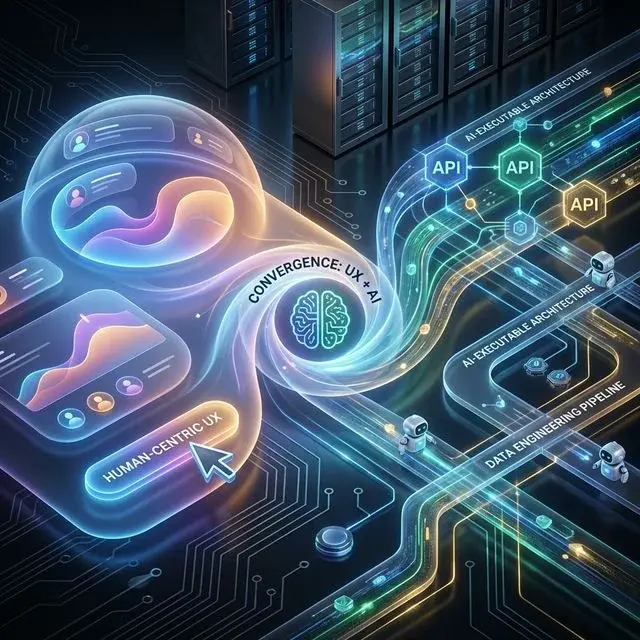
The Website Is No Longer the Interface — It's the Infrastructure
The biggest mistake companies in 2026 are making?
They're still designing websites like it's 2020.
Pages. Buttons. Animations. Conversion funnels.
Meanwhile, AI agents are executing tasks directly inside websites without asking permission from the UI.
The web has pivoted.
Websites must now serve two masters:
- Humans who browse
- AI agents that execute
This is not theoretical. Enterprise adoption of agentic AI systems has accelerated rapidly across procurement, research, and automation sectors. Google Cloud's enterprise AI documentation highlights structured agent frameworks designed for workflow execution, not just content interaction (https://cloud.google.com/vertex-ai/docs).
The question is no longer:
"Does your website look modern?"
It is:
"Can your website be executed by autonomous systems?"
At Power Digital Media in Jackson, MS, we build for both.
1. Agentic UX & Machine-Executable Architecture
From Visual Layouts to Action Zones
In 2026, websites must be Agent-Navigable.
Agentic UX is the discipline of designing digital environments where AI agents can:
- Book appointments
- Submit forms
- Retrieve structured data
- Complete purchases
- Execute research workflows
OpenAI's research division continues advancing vision-to-action systems capable of browser interaction (https://openai.com/research), while Google's Vertex AI Agents documentation confirms API-driven automation layers designed for enterprise orchestration (https://cloud.google.com/vertex-ai/generative-ai/docs/agents).
But here's the shift:
AI agents require shared context, not visual styling.
They don't care about your hero image.
They care about structured pathways.
The Enterprise Architecture Shift
Enterprise architecture consultancy ValueBlue has emphasized the move from static blueprints to machine-readable context models — infrastructure that agents can query dynamically instead of interpreting visually.
The implication?
Websites must evolve into:
- Structured execution frameworks
- Queryable data layers
- Deterministic navigation systems
This is where most local businesses — including many in Mississippi — are dangerously behind.
Implementation: The llms.txt Standard
Just as robots.txt guided search crawlers, llms.txt is emerging as a machine-readable guide for AI agents.
It allows you to:
- Summarize key pages
- Highlight transactional endpoints
- Declare execution pathways
- Identify "money pages"
This supports AI agents like GPTBot and PerplexityBot in understanding your site architecture at a structural level.
Combined with structured schema (https://developers.google.com/search/docs/appearance/structured-data/intro-structured-data), this transforms your site into:
Agent-Executable Infrastructure.
Monitoring AI Interaction
Google Search Console's AI interaction modes now allow monitoring of how machine systems interpret site execution paths (https://developers.google.com/search).
This is no longer optional for enterprise brands.
Jackson-based companies competing nationally must adopt this visibility layer.
2. High-Performance CSS & The Interop 2026 Standard
The End of the JavaScript Tax
For years, animation libraries like GSAP and Framer Motion added expressive movement — but at a cost:
- Increased JavaScript payload
- Slower interaction times
- Higher INP (Interaction to Next Paint) delays
Google's Core Web Vitals documentation emphasizes interaction responsiveness as a ranking factor (https://web.dev/vitals).
Interop 2026 changes the game.
The cross-browser collaboration initiative (tracked publicly via https://caniuse.com and browser dashboards) has standardized advanced CSS capabilities that eliminate the need for heavy JS animation layers.
What Interop 2026 Enables
WebKit's engineering blog (https://webkit.org/blog/) and Mozilla Hacks (https://hacks.mozilla.org/) confirm support for:
- Advanced attr() usage
- Container Style Queries
- Scroll-driven animations
- Cross-document View Transitions
These allow:
- Complex motion without JS
- Dynamic logic within CSS
- High-performance animation pipelines
This reduces:
- JavaScript payload
- INP delay
- Execution friction
Sites loading under 1.5 seconds consistently outperform slower competitors in visibility and engagement — and performance correlates strongly with search visibility per Google's performance documentation.
Implementation for Enterprise Clients in Jackson, MS
At Power Digital Media, our build philosophy now includes:
- Scroll-driven CSS animation
- View Transition API adoption
- Container Query-first layout systems
- Zero-JS interactive frameworks where possible
This is how we achieve elite Core Web Vitals 3.0 performance tiers.
Local businesses in Jackson competing in national SERPs must move beyond WordPress theme-level builds and into infrastructure-grade CSS architecture.
3. Multimodal & Sentient Interfaces
The Post-Screen Reality
UX Studio's 2026 research emphasizes that interfaces must be "graphical-first but multimodal-ready" — supporting seamless transition between touch, voice, and gesture depending on user context.
This aligns with broader accessibility and adaptive design trends emerging in accessibility discussions and WCAG evolution (https://www.w3.org/WAI/standards-guidelines/wcag/).
Multimodal design supports:
- Hands-free browsing
- Voice-triggered interaction
- Gesture navigation
- Gaze-assisted execution
This is not experimental.
It is becoming expected.
Sentient Interfaces & Emotion-Responsive UX
Emerging research in adaptive interfaces suggests UI complexity should adapt to user context.
Examples include:
- Reducing visual density under stress
- Adjusting contrast dynamically
- Switching to simplified navigation modes
While this space is still evolving, accessibility-first design principles support adaptive layouts and context-aware interfaces.
WCAG 3.0 development drafts emphasize inclusive and adaptable interaction models (https://www.w3.org/WAI/standards-guidelines/wcag/).
Implementation Strategy
To future-proof for multimodal interfaces:
- Build context-aware layers
- Enable input switching (voice, touch)
- Reduce reliance on fixed UI complexity
- Support accessibility-first architecture
For Jackson enterprises serving diverse populations, this is both a competitive and ethical imperative.
4. Localized EEAT & The Discover Factor
Jackson, MS — Local Authority Matters
Google Search Central confirms that expertise is evaluated topic-by-topic (https://developers.google.com/search/docs/fundamentals/creating-helpful-content).
Localized expertise builds:
- Regional authority
- Discover visibility
- Topic cluster strength
The February 2026 Discover shifts emphasize in-depth, regionally relevant authority.
For Jackson-based businesses, that means:
- Publishing Mississippi-focused expertise
- Hosting regionally optimized infrastructure
- Demonstrating real local engagement
Verified Content Blocks
Structured summaries designed for AI Overviews increase the likelihood of inclusion in machine-generated search summaries.
Using schema markup + structured summaries:
- Improves AI citation likelihood
- Supports agent extraction
- Reinforces entity authority
This is how local brands scale into national authority without abandoning regional roots.
The 2026 Web Design Pivot
The future of web design includes:
- Agent-Navigable infrastructure
- High-performance CSS architecture
- Multimodal adaptability
- Localized authority engineering
Most agencies are still designing pages.
Power Digital Media builds execution frameworks.
For Jackson, MS enterprises competing nationally, the pivot is not optional.
It is structural.
Frequently Asked Questions
What is Agent-Navigable web design?
Agent-Navigable web design is an architecture approach where websites are structured so AI agents can execute tasks such as booking, purchasing, and retrieving data without relying on traditional visual navigation.
What is Interop 2026 in web development?
Interop 2026 is a cross-browser initiative that standardizes high-performance CSS features such as scroll-driven animations, container queries, and view transitions, allowing complex motion without heavy JavaScript.
What are multimodal interfaces?
Multimodal interfaces allow users to interact with websites using multiple input methods including voice, touch, gesture, and gaze, improving accessibility and reducing friction in modern digital environments.
Does infrastructure affect SEO in 2026?
Yes. Infrastructure affects latency, crawl efficiency, and trust signals, which influence search visibility, especially for localized and enterprise-level websites.
Why is Agent-Executable architecture important?
As AI agents increasingly perform tasks directly on websites, agent-executable architecture ensures structured navigation, machine-readable pathways, and automation-ready workflows for both humans and AI systems.
Begin Your Digital Legacy.
Our team is ready to help you implement these strategies and build a brand that lasts.
Schedule A Free Consultation