Production AI Orchestration Beyond the API Endpoint
Damein Wayne Donald
Founder
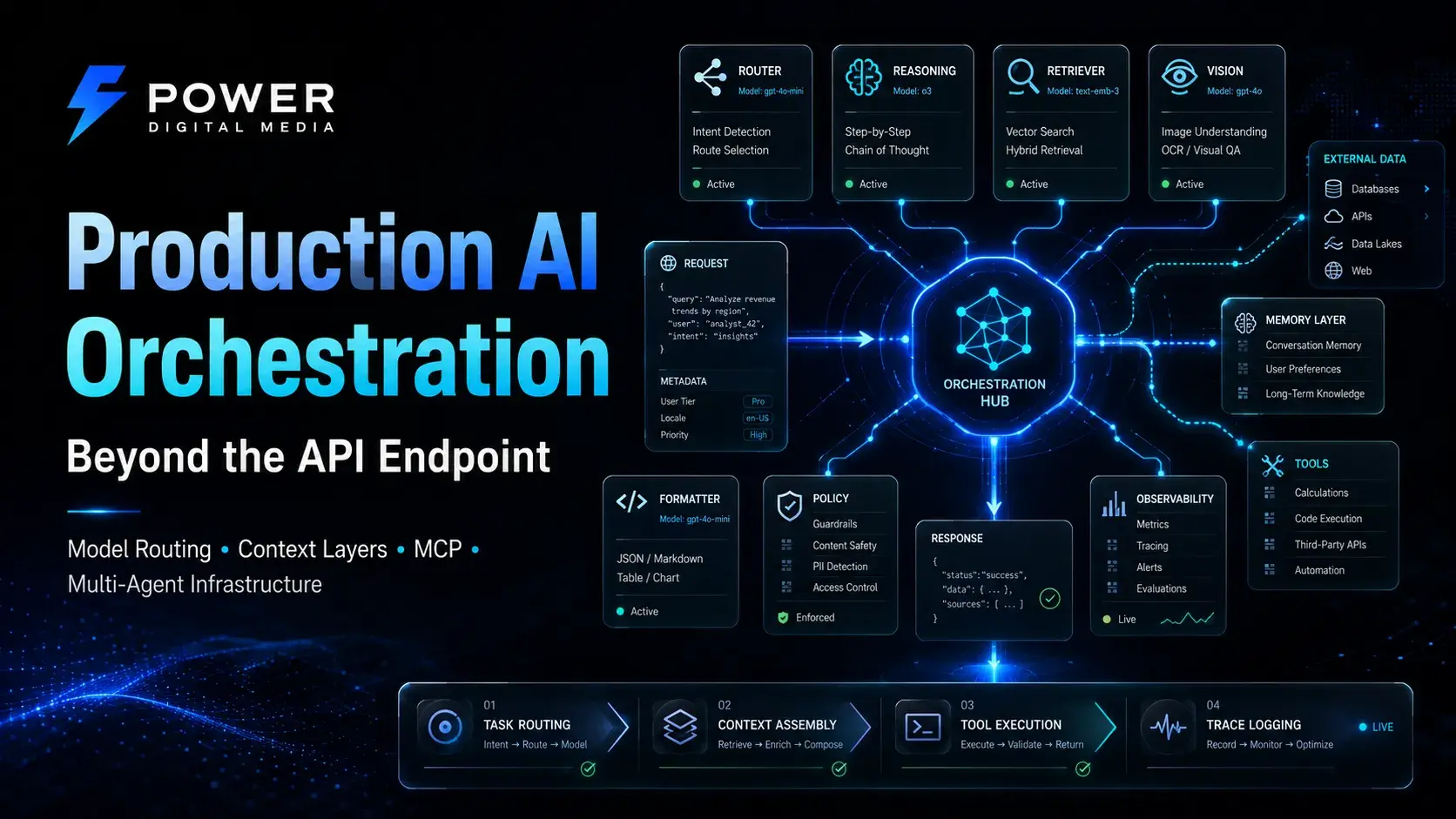
TL;DR — Direct Answer
A single API call to GPT-4o or Claude is not an AI strategy. Production AI orchestration is the infrastructure layer that sits between your business logic and the language model, handling model routing, fallback chains, structured context injection, and output validation at scale. At Power Digital Media in Jackson, Mississippi, we deploy multi-model orchestration across every client workflow — from content production to web development to SEO automation. The difference between a prototype and a production system is whether it survives its first 10,000 requests without human babysitting.
- Implication 1: Raw API calls fail silently. Orchestration catches degraded outputs, retries intelligently, and routes to fallback models before the end user notices.
- Implication 2: Multi-model routing assigns each task to the optimal model based on cost, latency, and capability — not vendor loyalty.
- Implication 3: JSON-LD context layers inject structured business data directly into the prompt pipeline, eliminating hallucination about your own products and services.
The Production Gap Nobody Talks About
Every agency and SaaS founder has shipped a proof-of-concept that calls an LLM endpoint and returns a result. That is the easy part. The production gap opens when that same endpoint faces concurrent users, model provider outages, context window limits, and outputs that need to be validated against business rules before they reach a customer.
At Power Digital Media, we learned this operating in Jackson, Mississippi — a market where our clients cannot absorb the cost of an AI-generated error reaching a customer-facing channel. The orchestration layer is not optional. It is the difference between a demo and a deployment.
Visibility matters here. Your AI pipeline is only as authoritative as your digital footprint. If your orchestration outputs rank, they need to be built on a foundation of verified AI search citation protocols. Structural integrity starts with a proper SEO audit before the first model call fires.
What is AI orchestration versus a single API call?
AI orchestration is the infrastructure layer that routes prompts to the correct model, manages fallback chains when a provider fails, injects structured context before inference, and aggregates outputs from multiple models into a single deliverable. A raw API call handles none of that.
The distinction matters because production traffic exposes every weakness a prototype hides. Rate limits hit. Providers deprecate endpoints. Context windows overflow. An orchestration layer anticipates these failure modes and handles them programmatically. Our podcasting workflows run through the same orchestration layer as our marketing copy — the router determines which model handles audio transcription versus which handles editorial generation.
How does multi-model routing improve reliability?
Multi-model routing assigns each task to the model best suited for it based on latency, cost, and capability profile. If the primary model returns a degraded response or times out, the router fails over to a secondary provider automatically, maintaining uptime without human intervention.
We operate a routing table at Power Digital Media that maps task types to model providers:
| Task Type | Primary Model | Fallback Model | Routing Logic |
|---|---|---|---|
| Long-form editorial | Claude 3.5 Sonnet | GPT-4o | Context window > 32K triggers Claude |
| Structured data extraction | GPT-4o | Gemini 1.5 Pro | JSON schema compliance score |
| Code generation | Claude 3.5 Sonnet | GPT-4o | Syntax validation pass rate |
| Audio transcription | Whisper Large v3 | Deepgram Nova-2 | Latency threshold 2s |
| Image analysis | Gemini 1.5 Pro | GPT-4o Vision | Cost per 1K tokens |
This is not theoretical. This is the actual routing configuration running against our web design and production client deliverables in Jackson, Mississippi.
What role does JSON-LD play in AI context injection?
JSON-LD provides a machine-readable semantic layer that pre-loads domain context into the prompt pipeline. Instead of relying on the model to infer business entities, the orchestration layer injects structured data about products, services, and organizational relationships directly into the context window.
The practical benefit is hallucination suppression. When the model receives a JSON-LD payload that defines your organization, your service areas, and your product catalog as structured entities before the user prompt arrives, it generates outputs grounded in verified data rather than training set approximations.
Every blog post on this site ships with full JSON-LD schema markup — Organization, WebPage, BlogPosting, FAQPage, BreadcrumbList — that serves dual duty: search engine structured data and AI context injection for our internal orchestration pipelines.
Why do most AI prototypes fail in production?
Three reasons dominate:
- No fallback logic. The prototype calls one endpoint. When that endpoint returns a 429 or 503, the system returns nothing. Production orchestration maintains a priority queue of providers and degrades gracefully.
- No output validation. The prototype trusts whatever the model returns. Production systems validate outputs against schemas, business rules, and confidence thresholds before forwarding to the user.
- No observability. The prototype logs nothing. Production orchestration records latency, token usage, model selection rationale, and output quality scores for every request. Without telemetry, you cannot optimize what you cannot measure.
We run observability dashboards across our Jackson studio that track model performance per workflow, per client, per day. The data informs routing table adjustments weekly. Source: LangSmith observability framework documentation provides the telemetry backbone for production LLM monitoring.
Can small businesses benefit from AI orchestration?
Yes. Orchestration frameworks like LangGraph, Semantic Kernel, and custom routers are available at every scale. A Jackson, MS business running three AI workflows benefits from the same fallback and routing discipline as an enterprise with three hundred.
The cost argument against orchestration collapses when you calculate the price of a single unvalidated AI output reaching a customer. A bad product description, a hallucinated service claim, or an incorrect data extraction costs more in reputation damage than six months of orchestration infrastructure.
Our SEO audit services integrate directly with our orchestration layer — the same pipeline that generates content validates it against search intent and factual accuracy before publication.
The Multi-Agent Architecture
Production orchestration at Power Digital Media operates on a multi-agent model. Each agent owns a domain:
- The Strategist Agent — Analyzes incoming requests, determines task decomposition, and assigns sub-tasks to specialized agents.
- The Content Agent — Handles editorial generation, tone matching, and brand voice enforcement across marketing deliverables.
- The Technical Agent — Manages code generation, structured data extraction, and schema validation for web development projects.
- The QA Agent — Validates all outputs against business rules, factual accuracy databases, and client-specific style guides before release.
Each agent routes through the same multi-model infrastructure. The Content Agent may prefer Claude for long-form prose but fall back to GPT-4o for short-form social copy. The Technical Agent may route code generation through Claude but send SQL optimization tasks to Gemini. The routing is task-aware, not agent-locked.
The Power Digital Media Action Checklist
- Map every AI workflow to a primary and fallback model provider.
- Implement structured context injection using JSON-LD payloads before the user prompt.
- Deploy output validation that checks schema compliance, confidence scores, and business rule adherence.
- Instrument observability on every model call — latency, tokens, model selection, and output quality.
- Schedule weekly routing table reviews based on production telemetry data.
- Run a baseline SEO audit to ensure AI-generated content lands on a structurally sound domain.
- Integrate your AI citation protocol with the orchestration output pipeline.
Core Entities
- Production AI Orchestration
- Multi-Model Routing
- JSON-LD Context Injection
- Multi-Agent Systems
- LLM Fallback Chains
- Output Validation Pipeline
- AI Observability Infrastructure
- Power Digital Media LLC (Jackson, Mississippi)
The workstation behind this orchestration
Running multi-agent inference with concurrent model calls, JSON-LD context processing, and real-time output validation requires hardware that does not flinch under parallel GPU and CPU loads. This is the actual workstation kit deployed in our Jackson, Mississippi studio — the machines running orchestration pipelines against live client traffic, not spec sheets from a wish list. Everything ships from our Showroom:
- NVIDIA RTX 5090 — 32GB GDDR7 VRAM. Runs local inference for validation agents alongside cloud model routing without memory pressure.
- AMD Ryzen 9 9950X3D — 16 cores, 3D V-Cache. Handles concurrent agent processes, context pre-processing, and observability telemetry without thermal throttling.
- Samsung 990 Pro 4TB — 7,450 MB/s sequential reads. Model weight loading and context cache retrieval never become the bottleneck in the orchestration pipeline.
- Corsair Dominator Titanium DDR5 — 64GB at 8000MT/s. Simultaneous agent memory allocation, JSON-LD parsing, and output validation buffers run without touching swap.
Executive FAQ
What is AI orchestration versus a single API call? AI orchestration is the infrastructure layer that routes prompts to the correct model, manages fallback chains when a provider fails, injects structured context before inference, and aggregates outputs from multiple models into a single deliverable. A raw API call handles none of that.
How does multi-model routing improve reliability? Multi-model routing assigns each task to the model best suited for it based on latency, cost, and capability profile. If the primary model returns a degraded response or times out, the router fails over to a secondary provider automatically, maintaining uptime without human intervention.
What role does JSON-LD play in AI context injection? JSON-LD provides a machine-readable semantic layer that pre-loads domain context into the prompt pipeline. Instead of relying on the model to infer business entities, the orchestration layer injects structured data about products, services, and organizational relationships directly into the context window.
Can small businesses benefit from AI orchestration? Yes. Orchestration frameworks like LangGraph, Semantic Kernel, and custom routers are available at every scale. A Jackson, MS business running three AI workflows benefits from the same fallback and routing discipline as an enterprise with three hundred.
Does Power Digital Media deploy multi-agent AI systems? Yes. Power Digital Media in Jackson, Mississippi operates multi-agent AI infrastructure across content production, web development, and SEO automation. Each agent is assigned a domain-specific role with its own model routing, context injection, and output validation pipeline.
Begin Your Digital Legacy.
Our team is ready to help you implement these strategies and build a brand that lasts.
Schedule A Free Consultation