GPT-5 vs Gemini in 2026: The Real Architecture Behind Multi-Model AI Workflows
Senior Principal Engineer
Power Digital Media
Power Digital Media | AI Infrastructure Series | 2026
Quick Answer
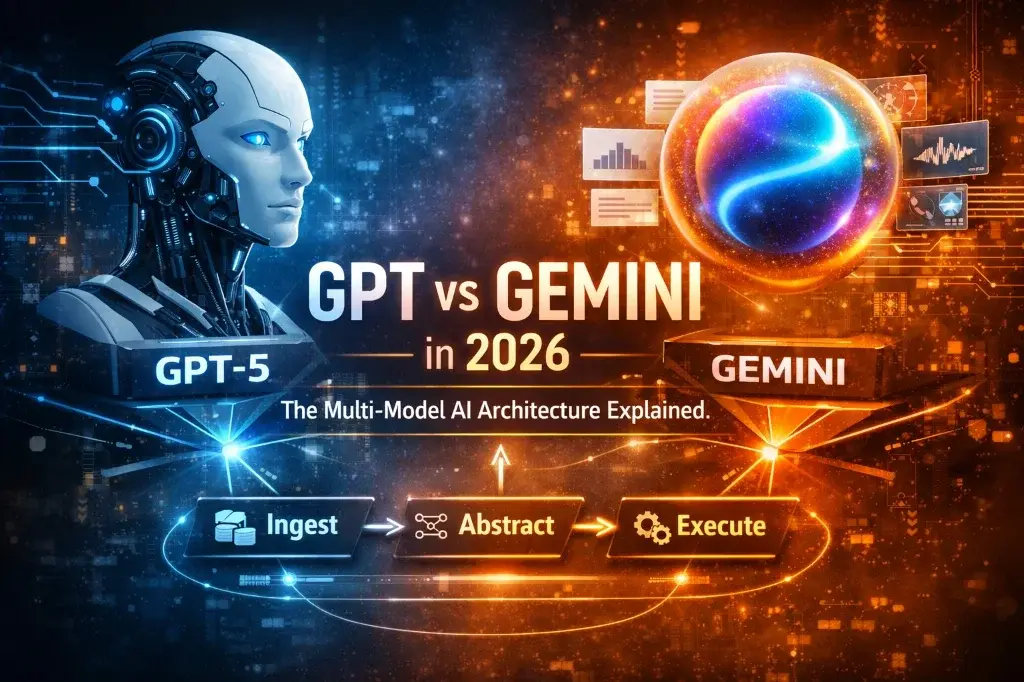
The “which AI is better” debate is outdated. In modern production environments, GPT-class and Gemini-class systems serve different roles within a unified intelligence stack. GPT excels at deep reasoning and execution, while Gemini excels at large-context ingestion and multimodal understanding. The real advantage comes from orchestration — using each model where it performs best.
Why the Old Comparison Model No Longer Works
For years, AI discussions revolved around single-model benchmarks and leaderboard scores. But modern deployments no longer rely on one model. Instead, advanced systems coordinate multiple specialized AI engines in structured workflows — a process known as model orchestration.
Research in multi-LLM systems shows that orchestrating multiple models improves contextual accuracy, reduces hallucination, and increases reliability compared to single-model architectures (Multi-LLM Orchestration Research).
Industry frameworks now define orchestration as coordinating multiple models to optimize performance, latency, and reasoning accuracy (Model Orchestration Overview).
The question has shifted from: Which model is better? to: Which model handles this layer of cognition best?
The Core Difference: Reasoning vs Context Scale
GPT-Class Models — Precision Reasoning and Execution
GPT-style systems excel in deep logical reasoning, structured decision chains, and code generation. In many comparative analyses, GPT-class models demonstrate stronger performance in reasoning-heavy tasks and coding scenarios, making them ideal for execution-focused workflows (GPT vs Gemini Capability Comparison).
Because of this, GPT is commonly used as the execution layer in multi-model architectures. We rely on the NVIDIA GeForce RTX 5090 (Primary Compute) to provide the local compute density required for these precision reasoning chains.
Gemini-Class Models — Massive Context and Multimodal Intelligence
Gemini-class systems are optimized for large document ingestion and multimodal interpretation. Research shows Gemini-type systems excel when processing large datasets and multimodal inputs, making them highly effective for context mapping and large-scale knowledge analysis (Gemini vs GPT Production Comparison).
In real deployments, Gemini often serves as the ingestion and abstraction layer, orchestrated by the high-velocity AMD Ryzen 9 9950X (System Orchestration) processor core.
The Multi-Model Architecture: How Modern AI Systems Actually Work
Modern AI systems operate as layered intelligence pipelines rather than single models.
Stage 1 — Ingestion (Context Mapping)
Large-context models analyze the full environment (codebases, documents, transcripts). The goal is situational awareness.
Stage 2 — Abstraction (Signal Extraction)
The system identifies what actually matters. Research in multi-agent orchestration shows that compressing large context into actionable signal dramatically improves reasoning accuracy (Reasoning-Aware Multi-Agent Framework).
A reasoning-optimized model executes code updates and logical corrections. Because execution models receive distilled signal rather than full noise, logical consistency and output stability increase significantly. This high-velocity data flow is supported by the Samsung 990 Pro 4TB NVMe (Data Velocity Tier) storage tier, feeding the high-capacity G.Skill Trident Z5 128GB DDR5 (Model Memory Pool) for low-latency model swapping.
Why Orchestration Beats Single-Model Systems
Single-model architectures often face tradeoffs between context size and reasoning precision. Orchestration resolves this by assigning each task to the model best suited for it. Multi-agent AI research confirms distributed intelligence systems outperform single-model approaches in complex environments (Multi-AI Agent Collaboration Study).
Real-World Applications of Multi-Model AI
These architectures reflect the industry shift from single-model intelligence to coordinated AI systems (AI Agent Orchestration — IBM).
- Software Engineering: Large repo ingestion → targeted refactoring.
- Media & Knowledge Systems: Multimodal transcription via the Rødecaster Pro II and speaker analysis.
- Data & Research: Cross-document pattern detection.
Further Reading & Sources
-
Multi-LLM Orchestration Engine for Context-Rich AI
https://arxiv.org/abs/2410.10039 -
Model Orchestration Overview — IBM
https://www.ibm.com/think/topics/llm-orchestration -
AI Agent Orchestration Explained — IBM
https://www.ibm.com/think/topics/ai-agent-orchestration -
Reasoning-Aware Multi-Agent Coordination Framework
https://arxiv.org/abs/2510.00326 -
Multi-AI Agent Collaboration Research (ACM)
https://dl.acm.org/doi/full/10.1145/3745238.3745531 -
Gemini vs GPT Capability Comparison
https://www.clarifai.com/blog/gemini-2.5-pro-vs-gpt-5 -
Gemini vs ChatGPT Production Analysis
https://www.ninetwothree.co/blog/gemini-vs-chatgpt
Begin Your Digital Legacy.
Our team is ready to help you implement these strategies and build a brand that lasts.
Schedule A Free Consultation