Ambient Intelligence in 2026: Real Uses, Risks, and Business Impact
Senior Principal Engineer
Power Digital Media
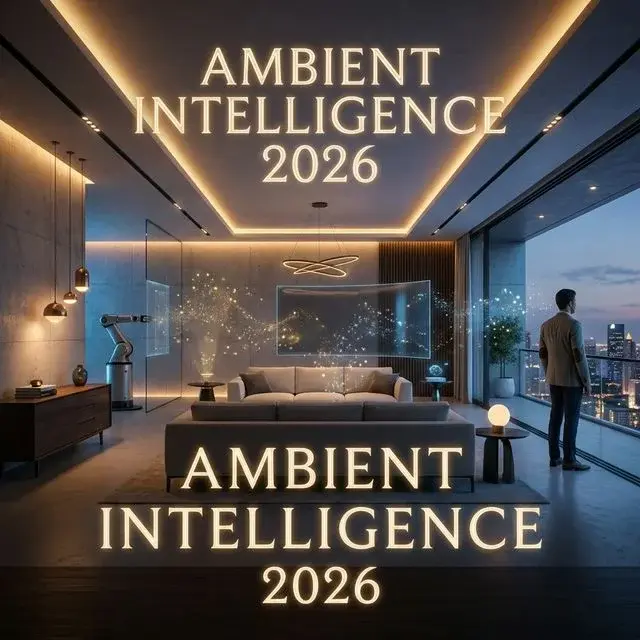
Power Digital Media — Intelligence Systems Series
Understanding Ambient Intelligence in Today’s World
Ambient Intelligence (AmI) describes environments where digital systems quietly observe, learn, and respond to human presence. Instead of users actively interacting with devices, the environment adapts automatically — adjusting lighting, content, recommendations, and services in real time.
The concept combines artificial intelligence, connected sensors, and data analytics to build responsive environments that operate continuously in the background. Research into smart environments shows AmI systems rely heavily on context awareness and predictive modeling to adapt to users without direct input (European Commission — Ambient Intelligence Overview).
While once theoretical, these systems are now appearing in retail, healthcare, smart offices, and digital marketing platforms.
Real-World Use of Ambient Intelligence
Ambient Intelligence is most visible where environments adapt dynamically to human behavior.
In retail, intelligent systems adjust digital displays, product suggestions, and lighting based on real-time shopper activity. Studies on smart retail environments show adaptive systems can improve engagement and customer experience when used responsibly (Deloitte — Smart Retail and Personalization).
In healthcare, sensor-driven environments monitor patient movement, sleep patterns, and vital signs, allowing early intervention when anomalies are detected. Research into smart health environments confirms continuous monitoring improves responsiveness and care quality (National Institutes of Health — Smart Healthcare Systems).
These implementations show that AmI is not about futuristic automation — it is about responsive environments built around human context.
How Ambient Intelligence Enables Personalization
The strength of Ambient Intelligence lies in its ability to process context continuously. Instead of reacting to explicit commands, AmI systems analyze behavioral signals, environmental data, and historical patterns to predict user needs.
Advanced personalization models use real-time behavioral analytics to tailor experiences, from targeted content delivery to adaptive environments. Research in digital personalization shows predictive systems can improve user engagement when data is handled responsibly (McKinsey — The Value of Personalization).
However, effective personalization depends on infrastructure quality, data governance, and system tuning.
Infrastructure Requirements Behind Ambient Intelligence
Ambient Intelligence relies on several technical layers working together:
- Connected sensors and IoT devices (anchored by the Lutron Athena AI Hub)
- Real-time data processing
- Context-aware AI models
- Edge and cloud computing coordination
Because AmI systems must respond quickly to environmental changes, latency and data throughput become critical. Research in edge computing shows moving computation closer to the data source improves responsiveness and reduces processing delay in real-time environments (IBM — Edge Computing Explained).
Building reliable AmI systems requires coordination between hardware, software, and data pipelines rather than isolated technology upgrades. Our production studios leverage the Hue Play HDMI Sync Box 8K and Nanoleaf Lines Ultra to demonstrate these ambient response loops in real-world creative environments.
Privacy and Ethical Concerns
Ambient Intelligence raises important questions about privacy. Continuous data collection, even when passive, creates risk if not managed properly.
Regulatory frameworks such as GDPR emphasize transparency, user consent, and responsible data handling in environments where behavioral data is collected continuously (European Commission — Data Protection and GDPR).
Another concern is algorithmic bias. When systems learn from incomplete or skewed data, personalization may unintentionally produce unfair or inaccurate outcomes. Responsible AI design must include transparency, testing, and oversight.
Organizations adopting AmI must treat data protection as part of system architecture, not an afterthought.
Where Ambient Intelligence Helps — and Where It Doesn’t
Ambient Intelligence is most effective when:
- Environments generate continuous behavioral data
- Context awareness improves user experience
- Automation reduces repetitive decision processes
It is less effective when:
- Data quality is inconsistent
- Infrastructure cannot support real-time processing
- Privacy governance is weak
Understanding both strengths and limitations prevents overinvestment and unrealistic expectations.
Implementation Challenges
Deploying Ambient Intelligence introduces technical and operational challenges:
- Integrating legacy systems with modern IoT infrastructure
- Managing continuous data flow
- Ensuring system stability and low latency
- Avoiding excessive reliance on automation
Research into smart environments highlights that system integration — not AI capability — is often the primary barrier to successful implementation (IEEE — Smart Environment Architecture).
Organizations must design for scalability, not just functionality.
The Future of Ambient Intelligence
Ambient Intelligence is evolving toward more adaptive, decentralized systems. Emerging architectures combine edge processing, real-time analytics, and predictive AI to create environments that respond instantly to changing conditions.
The direction is clear: technology is moving from reactive systems toward context-driven environments that operate continuously in the background.
However, long-term success depends on balancing innovation with privacy, transparency, and system reliability.
Final Take
Ambient Intelligence is no longer theoretical. It is already shaping how environments respond to people in retail, healthcare, and digital ecosystems.
The opportunity is significant, but so are the responsibilities. Organizations that combine technical discipline, ethical data practices, and realistic implementation strategies will see the greatest benefit.
Begin Your Digital Legacy.
Our team is ready to help you implement these strategies and build a brand that lasts.
Schedule A Free Consultation